Модульные стальные балочные и арочные мосты позволяют владельцам проектов заменить месяцы строительства на площадке заводскими сегментами, которые перевозятся в стандартных контейнерах и собираются за считанные дни. В этом руководстве объясняются пролёты, марки мостовой стали, стандарты нагрузок, болтовые соединения, защита от коррозии, отгрузка, монтаж, документация по качеству и оценка поставщиков для международных покупателей.
Why International Buyers Are Moving to Modular Steel Bridges
Every bridge project eventually comes down to the same three questions: how quickly can the crossing be open, how confidently can the structure carry its design loads for decades, and how predictable can the cost be. For project owners, EPC contractors, and infrastructure agencies across Southeast Asia, the Middle East, Africa, Latin America, and Central Asia, modular steel bridges have become a persuasive answer to all three. Instead of months of on-site formwork and curing, the primary structure is fabricated in a factory, shipped in standard containers, and bolted together on site in days.
This guide walks through the complete picture: what a modular steel bridge actually is, how the engineering works, which specifications genuinely matter to a buyer, how shipping and erection are organized, and how to evaluate a manufacturer before you sign a contract. It is written from the perspective of the buyer's engineering and procurement team, not as a brochure.
The product facts in this guide reflect the modular steel girder and arch bridge solutions offered by Jidian Construction Materials Co., Ltd., a steel structure manufacturer based in Xiamen, Fujian, China. The company participated in the formulation and review of China's national steel structure standards and specifications, operates an annual steel structure capacity of 360,000 tons alongside an annual enclosure system capacity of 1,000,000 square meters, and has delivered more than 2,000 completed projects across more than 50 countries. Wherever a specific number appears below, it comes from the company's published product specifications. Where an outcome depends on your particular site and scope, this guide says so plainly rather than inventing figures.
The structure of the guide follows a realistic procurement sequence: first the concept and engineering fundamentals, then materials, loading, connections, and corrosion protection, then logistics, erection, and quality documentation, and finally supplier evaluation, cost drivers, and a step-by-step buying timeline.
What Is a Modular Steel Bridge?
A modular steel bridge is a crossing whose primary load-carrying structure is divided into factory-built segments that are designed to be transported, lifted, and joined together on site with bolted connections. The segmentation is not an afterthought; it is decided during structural design so that each segment respects shipping dimensions, crane capacities, and bolted splice positions. For the modular bridge range described in this guide, typical spans run from 20 to 80 meters, and the available structural types include box girder, truss, and arch configurations.
This is a fundamentally different delivery model from cast-in-place concrete construction. With concrete, the critical path runs through the site: formwork, reinforcement, casting, and curing each lock the schedule to local labor, weather, and material supply. With a modular steel bridge, fabrication proceeds in a controlled factory environment while foundations and abutments are built on site in parallel. The two work streams meet for a short, highly predictable erection window.
The practical consequences for an international buyer are significant:
- Parallel progress. Site preparation and factory fabrication happen at the same time, compressing the overall calendar.
- Factory-controlled quality. Welding, surface preparation, and coating happen indoors, under documented procedures, before anything ships.
- Fast, weather-tolerant erection. Bolted assembly is far less sensitive to rain, humidity, and temperature than site casting.
- Economical shipping. Segment dimensions are chosen so that modules fit standard 40-foot containers, which keeps freight simple and cost-effective for most projects.
- Clear inspection points. Every segment arrives with fabrication records, and bolted splices can be checked visually and with torque verification after assembly.
Modular does not mean temporary or lightweight. These are permanent bridges engineered for highway-class loading, built from bridge-grade steel, and protected with coating systems designed for multi-decade service. Modularity is a production and logistics strategy, not a structural compromise.
Why Steel Is the Default Choice for Fast-Track Crossings
Steel earns its place in bridge projects through an unusually favorable strength-to-weight ratio. Because structural steel carries far higher stress than concrete before yielding, a steel superstructure needs less material by weight, which reduces demand on foundations and piers. That same lightness keeps individual lifts within the reach of commonly available mobile and crawler cranes, which matters enormously on remote sites where heavy lifting equipment is scarce or expensive to mobilize.
Steel is also dimensionally predictable. A welded steel girder fabricated to tolerance does not shrink, creep, or require curing time. Once a segment is bolted into position and connections are verified, it carries load. There is no twenty-eight-day wait for strength gain, no formwork cycle, and no seasonal dependence on curing conditions.
For buyers thinking about whole-of-life value, two further characteristics stand out. First, steel structures are inspectable and repairable: coatings can be maintained, individual members can be assessed, and bolted connections can be re-verified during service. Second, steel is recyclable at end of life, which increasingly appears in sustainability requirements for publicly funded infrastructure. Neither characteristic replaces a disciplined maintenance plan, but both make the long-term cost of ownership easier to manage than alternatives whose deterioration is hidden until it is expensive.
The trade-off is honest and manageable: steel must be protected against corrosion and designed against fatigue. Both are solved problems with known standards, and both are covered in detail in the sections on steel grades, bolted connections, and protective coatings below. A buyer who understands those three topics understands most of what separates an ordinary steel bridge from an excellent one.
How Modular Design Actually Works
Modular bridge design starts from the site and works backward to the factory. The engineer establishes the required span arrangement, deck width, vertical and horizontal alignment, and design loading. The structure is then divided into transportable segments whose geometry respects three constraints at once: structural efficiency, shipping envelope, and erection sequence.
For the modular systems in this guide, segments are proportioned to fit standard 40-foot shipping containers. This single decision quietly shapes the entire logistics chain. Container-sized modules can move on ordinary trucks and container vessels without special permits in most jurisdictions, can be staged in ordinary port yards, and can be loaded and unloaded with standard container-handling equipment. For projects in port cities or served by regular container services, this can be the difference between routine freight and a project-delaying logistics negotiation.
Each structural type brings its own character to a project:
- Box girder bridges use closed steel sections with high torsional stiffness and clean external lines. They suit alignments where appearance matters and where the deck structure must integrate neatly with road barriers and drainage.
- Truss bridges use triangulated members to carry load efficiently in axial tension and compression. They are material-efficient, their geometry is easy to inspect, and the through-truss form keeps deck depth shallow even at the upper end of the span range.
- Arch bridges carry the deck partly through arch action, transferring thrust to foundations. They deliver a distinctive silhouette for civic and landmark crossings, and they are most attractive where sound foundations can absorb the thrust.
Choosing among them is an engineering decision, not a catalog selection. Span length, site geometry, foundation conditions, shipping route, and erection crane availability all feed the choice. A competent manufacturer will walk you through the trade-offs with preliminary calculations before any commitment, and the differences usually show up clearly in steel tonnage, erection method, and foundation loads.
Deck construction and ancillary components, such as expansion arrangements, barriers, and drainage details, vary by project and are fixed during detailed design. Treat any supplier who quotes a bridge without asking about your deck build-up, wearing surface, and utilities with appropriate skepticism: those details change the dead load the structure must carry.
Steel Grades: Why Bridge Steel Is Not Building Steel
The single most consequential material decision in a steel bridge is the steel grade specified for primary members. The modular bridges in this guide are fabricated from bridge steel grades Q345qC and Q370qC produced to the Chinese bridge steel standard GB/T 714, with low-temperature impact toughness performance stated at minus 20 degrees Celsius for this product range.
The letter designation matters. Bridge steel is a distinct family from the structural grades used in buildings. The company's own industrial buildings and warehouses, for comparison, are fabricated from Q345B and Q355B welded H-section steel to building structure standards, which is entirely appropriate for static-dominant building frames. A bridge superstructure, however, lives under moving, repeating, dynamic loads for its entire service life, and it must retain toughness through cold nights and, in some markets, through genuinely harsh winters. Bridge grades are produced, tested, and certified for exactly that duty.
A simplified comparison for buyers:
| Steel grade | Standard family | Typical use | Why it matters to buyers |
|---|---|---|---|
| Q345B / Q355B | Building structural steel | Portal-frame warehouses, workshops, industrial buildings | Cost-effective for static loads; the right choice for building frames |
| Q345qC | GB/T 714 bridge steel | Primary members of highway and river bridges | Produced and tested for bridge duty, including low-temperature impact toughness |
| Q370qC | GB/T 714 bridge steel | Primary members where higher strength reduces tonnage | Higher-strength option; selection depends on span and loading, decided in design |
Three practical questions help a buyer test a supplier's material discipline. First, can the supplier produce mill certificates that tie each heat of steel to the segments made from it? Second, does the supplier's incoming inspection verify that delivered plates match the certified grade before fabrication begins? Third, are welding procedures qualified against the bridge grade actually being used, rather than a generic structural procedure? A manufacturer who answers all three confidently, with documents rather than assurances, is treating materials as an engineering system rather than a commodity line item.
Grade selection also interacts with tonnage and cost. A higher-strength grade can reduce plate thickness and total steel weight on longer spans, which can partially offset the grade premium and reduce shipping weight. Whether that trade pays off for a given span is a design question, and the honest answer is reached with calculations, not rules of thumb.
Loading Standards: What Your Bridge Must Carry
A bridge is defined by its loads, and the design loading must be agreed before detailed engineering begins. The modular bridge range in this guide is engineered for China highway Grade-I loading and for AASHTO HS-20 truck loading, which together cover the design conventions used across a large share of the markets these bridges serve.
For buyers, the important skill is translating a local requirement into a clear instruction. A design live-load model, whether it comes from a national highway code, AASHTO conventions, or a Eurocode-based national annex, specifies how vehicles and lane loads are arranged on the deck, and it is combined with dead load, dynamic amplification, wind, temperature effects, and, where applicable, pedestrian loading and special vehicles. The manufacturer's engineers adapt the structural design to the governing code when the buyer states it clearly at inquiry.
A practical checklist for the load specification conversation:
- Design code and edition. Name the standard your approving authority will check against, including the year.
- Traffic composition. Expected vehicle types, axle configurations, and any exceptional vehicles such as heavy haulage or agricultural equipment.
- Deck width and lane arrangement. Traffic lanes, shoulders, walkways, and barriers all change the load model and the structure.
- Special actions. Seismic parameters, wind speed, flood and debris loads on piers, and ship or barge impact where the crossing spans a navigable waterway.
- Future proofing. Whether the owner wants reserve capacity for a future wearing surface or heavier classification.
Beyond static strength, bridges are checked for fatigue: the accumulated effect of millions of load cycles over the design life. This is precisely why bridge-grade steel, qualified welding procedures, and carefully detailed bolted connections matter so much. Fatigue performance is engineered at the detail level, and it cannot be added later by inspection. When you evaluate a supplier, ask how fatigue-critical details are treated in design and how the fatigue-rated bolted connections are specified, installed, and verified.
Bolted Connections: The Heart of Modular Construction
The modular delivery model depends on field joints that can be made quickly, reliably, and verifiably by ordinary site crews. That is why the bridges in this range use fatigue-rated bolted connections rather than site welding as the primary joining method at segment splices.
The advantages compound in practice:
- Quality moves to the factory. Welding happens indoors under qualified procedures and full inspection; the site crew performs a bolted splice instead of a field weld in variable weather.
- Speed. Bolted splices are assembled with cranes and torque-controlled tools in a fraction of the time required for site welding and testing.
- Verifiability. Bolt installation can be checked by torque verification and visual inspection, giving the owner's engineer a simple, repeatable acceptance test for every connection.
- Fatigue discipline. Connection details are classified and detailed for fatigue performance, consistent with the fatigue-rated design philosophy of the structure.
- Logistics tolerance. Bolted assembly tolerates the small dimensional realities of transport and handling without rework of welded joints.
Buyers should still ask specific questions about execution. How are faying surfaces prepared where slip-critical behavior is required? What installation procedure and bolt lot documentation will be provided? How is torque verification recorded, and who witnesses it? A manufacturer with an in-house inspection culture will answer in terms of procedures and records, because that is how bridge quality is actually maintained.
It is worth being precise about one boundary: factory welding and site bolting are complementary, not competing. The welded portions of each segment benefit from controlled conditions and one hundred percent ultrasonic testing of butt welds before shipping, while site joints use bolts precisely because site conditions make welding slower and harder to verify. The result is a structure whose riskiest operations are concentrated where quality control is strongest.
Corrosion Protection: Buying Three Decades, Not Three Years
Unprotected steel corrodes; protected steel endures. For the modular bridges in this range, the protective system is a thermal spray zinc coating with an epoxy intermediate coat and a polyurethane topcoat, a system specified for aggressive C4 and C5 corrosivity categories with a stated design service of more than thirty years.
That specification deserves translation. Thermal spray zinc, also called metalizing, applies a metallic zinc layer to blast-cleaned steel. The zinc layer protects in two ways: it is a barrier, and it is sacrificial, corroding preferentially to protect the steel at any scratch or edge. The epoxy coat builds barrier thickness and seals the zinc, while the polyurethane topcoat provides color stability, UV resistance, and the first line of defense against the environment. Systems of this family are standard practice for marine and industrial atmospheres precisely because each layer does a distinct job.
Why this matters commercially: repainting a bridge is expensive, disruptive, and, over a fifty-year life, may need to happen several times with lesser systems. A coating system engineered for C4 and C5 exposure from day one changes the maintenance economics of the whole asset. For crossings near the sea, in industrial zones, or in tropical climates, buyers should treat the coating specification as a first-class line item in evaluation, not a finishing detail.
Surface preparation discipline is where coating systems live or die. The manufacturer's inspection regime for these structures includes derusting grade detection on prepared surfaces before any coating is applied, which is the checkpoint that separates a genuine multi-decade system from a cosmetic one. Coating thickness is then verified and documented so the owner receives records, not promises.
Two companion guides on this site go deeper into these topics for buyers who want the full background: a complete buyer's guide to anti-corrosion coating systems for steel structures in coastal, industrial, and tropical projects, and a detailed article on steel structure lifespan, durability, and long-term value.
Shipping and Logistics: Why 40-Foot Containers Shape the Design
Freight is where many international bridge projects quietly lose time and money. Oversized girder sections can require breakbulk vessels, special trailers, route surveys, permits, and escorts, each of which is a schedule risk in a foreign jurisdiction. The modular bridges in this guide take the opposite path: segment geometry is designed so that modules fit standard 40-foot containers, enabling routine, economical container shipping.
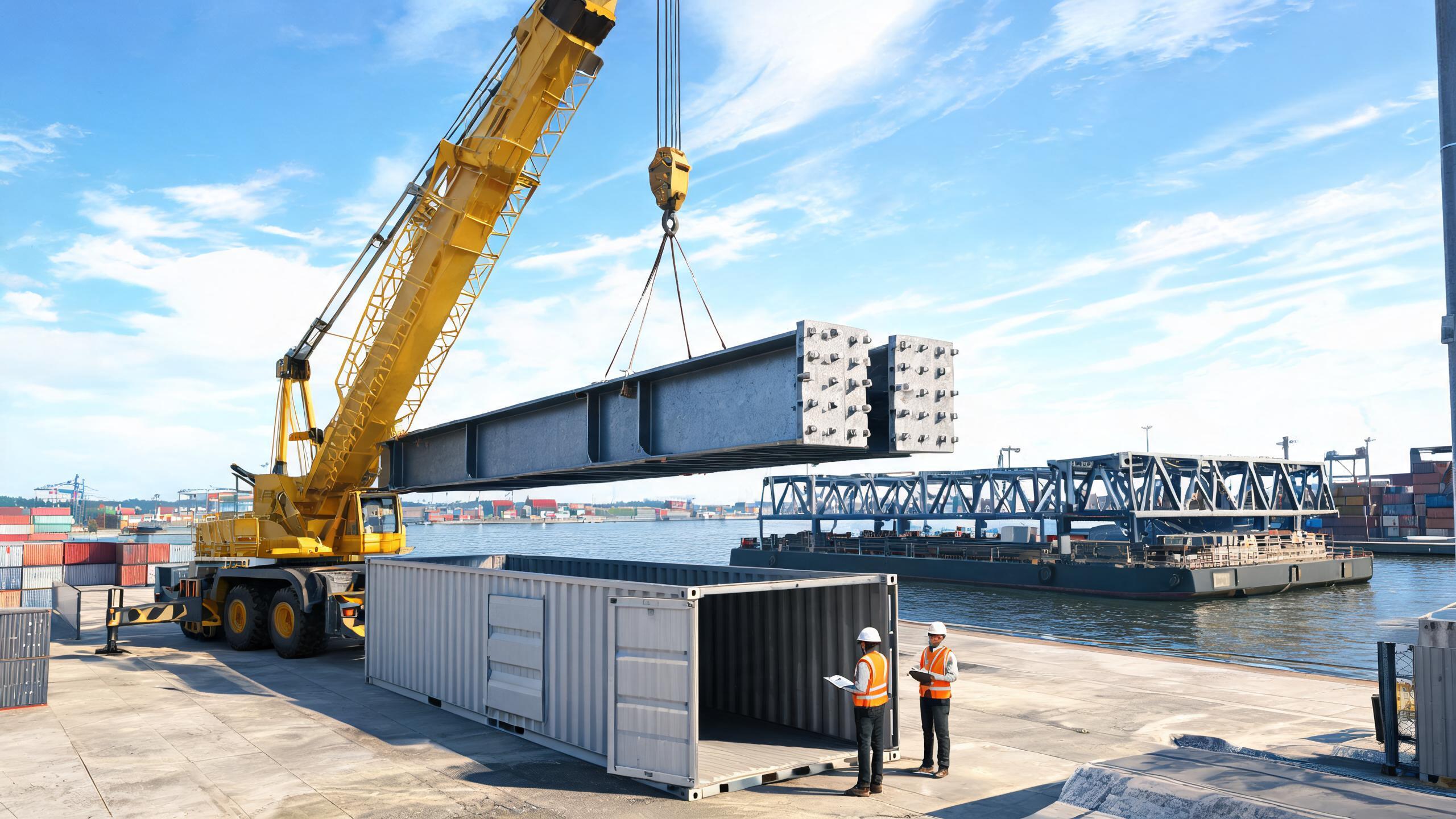
For the buyer, container-compatible modules change the logistics conversation from negotiation to scheduling:
- Predictable freight. Standard containers move on regular services to most ports, with published schedules and rates.
- Simple port handling. No special lifting gear is required at discharge, and segments can be staged in ordinary container yards.
- Easier inland transport. Container-sized loads travel on standard trailers, avoiding abnormal-load permits in most jurisdictions.
- Natural sequencing. Containers can be loaded so that segments arrive at the site in erection order, keeping staging areas small.
Good logistics execution is administrative as much as physical. Ask how the supplier packages and marks segments, whether packing lists map containers to erection positions, and how shipping documents are coordinated with your customs broker. A supplier who ships bridges internationally as a routine business will have answers, checklists, and examples of documentation sets.
Buyers whose sites sit far from container ports should raise overland transport openly at inquiry. Container-compatible segments still travel better than oversized loads, but final-mile constraints, bridge weight limits on access roads, and site crane positions belong in the logistics plan early, not discovered at delivery.
Erection: What Seven to Fifteen Days Actually Looks Like
For a typical 40-meter span, the stated on-site erection window for this modular bridge range is seven to fifteen days. That number deserves unpacking, because it is one of the most valuable features of modular delivery and also one of the most misunderstood.
The window is short because almost everything that usually consumes site time has already happened in the factory: cutting, welding, inspection, coating, and trial assembly discipline are complete before shipment. What remains on site is positioning segments, making bolted splices, verifying connections, and completing deck works. Those are real activities with real crews and cranes, but they are short, sequential, and weather-tolerant.
A typical erection sequence looks like this:
- Readiness checks. Verify foundation and abutment positions, anchor arrangements, and access for cranes and trailers.
- Staging. Containers are set out in erection order, and segments are checked against shipping documents.
- Segment placement. Segments are lifted in sequence and aligned, with temporary works used where the design requires them.
- Bolted splices. Connections are made with the specified bolts and installation procedure, followed by torque verification.
- Inspection and acceptance. The owner's engineer verifies geometry and connections, and records are handed over.
Three factors move projects toward the fast end of that seven-to-fifteen-day range: foundations completed and verified before steel arrives, a clear crane plan agreed in advance, and a site crew that has reviewed the erection sequence with the supplier's engineers. None of these is exotic; all of them are decided by planning quality.
Buyers should also ask about supervision. The company's engineering support model covers drawing design, steel structure manufacturing, and on-site construction, with experienced engineer teams available for comprehensive support services, and a customer service team that maintains 24-hour response. For an overseas erection crew that has not built a modular bridge before, a manufacturer's site engineer for the critical first days is often the highest-value line in the whole contract.
Quality Control and the Documentation Package
In international procurement, quality you cannot document is quality you cannot defend in a dispute, an audit, or a financing review. The quality system behind these bridges is built around inspection that happens continuously during fabrication, not just at the end.
The backbone of that system includes:
- Raw material control. An in-house inspection team verifies incoming material quality before fabrication, tying plates and sections to mill certificates.
- Weld inspection. Butt welds receive one hundred percent ultrasonic testing before segments are cleared for shipping.
- Surface preparation checks. Derusting grade detection verifies blast-cleaned surfaces before coating.
- Coating verification. Coating system application is checked and recorded against the specified system.
- Complete NDT documentation. The bridge product is delivered with a complete non-destructive testing documentation package, so the owner's engineer and any third party can review what was tested and what the results were.
Behind these activities sits a certification framework that international buyers will recognize: the company's quality management and products are backed by ISO 9001, CE, SGS, and BV certification, and welding procedures are qualified for CE-marked projects, including Italy welding qualification. Third-party inspection by internationally recognized bodies is a normal part of how such programs operate, and buyers who plan to appoint an independent inspector should say so early so witness points are built into the production schedule.
A useful evaluation habit is to ask for a sample documentation set from a comparable project structure, with commercially sensitive details redacted. What you are reviewing is not the numbers themselves but the system: traceability from steel heat to segment, weld maps with test outcomes, coating records, and bolt lot documentation. A manufacturer with a genuine quality culture produces these without drama because it is simply how they work.
Credibility at company level is also verifiable beyond certificates. The company's steel structure work has been recognized with letters of thanks from organizations including the Beijing 2022 Winter Olympics Organizing Committee and the China Academy of Launch Vehicle Technology, reflecting delivery on demanding engineering projects. Recognition of that kind does not replace technical due diligence, but it is meaningful evidence that the organization has performed under scrutiny on major programs.
Site Conditions: Wind, Seismic Action, and Temperature
A bridge is inseparable from its environment, and the environmental load cases deserve explicit attention in both design and contract. Wind is the most common: for exposed crossings and coastal sites, wind load design shapes railings, deck edges, and in strong-wind regions the overall structural arrangement. Buyers working in cyclone-prone or coastal areas may also find the site's article on how wind load design affects steel structure safety in coastal regions useful background on how wind pressures translate into engineering requirements.
Seismic action matters across many of the markets these bridges serve. Ductile detailing, connection capacity, and bearing and expansion arrangements are all influenced by seismic parameters, which the buyer's engineer should supply from the governing national code. The same is true of temperature: bridge structures expand and contract, and the low-temperature impact toughness performance stated for this steel range, verified at minus 20 degrees Celsius, is relevant to projects in cold-climate markets as well as to high-altitude sites in otherwise warm regions.
Water conditions deserve their own paragraph for river crossings: flood levels, debris loading, scour around piers, and, on navigable waters, vessel impact all influence the design. These are site data, not supplier choices, and providing them early prevents redesign cycles. The most efficient way to handle environmental inputs is a single data sheet agreed between the buyer's engineer and the manufacturer before detailed design begins.
Design Collaboration: From Inquiry Data to Approved Drawings
The design phase is where a modular bridge earns or loses most of its value, and it works best as a structured collaboration rather than a hand-off. The buyer's engineer owns the project requirements: geometry, loading, site data, and acceptance criteria. The manufacturer's engineers own the translation of those requirements into a buildable, shippable, erectable structure. Each iteration should narrow the open questions rather than multiply them.
A workable collaboration rhythm looks like this. It begins with the inquiry data sheet described earlier, continues through a preliminary scheme in which the manufacturer proposes a structure type, span arrangement, estimated steel tonnage, segment breakdown, and logistics concept, and matures into detailed design with calculations and drawings that the buyer's engineer reviews against the governing code. Fatigue-critical details, bolted splice positions, and erection staging deserve explicit review, because those decisions lock in both performance and site productivity.
Documentation quality is part of engineering quality. A manufacturer whose engineers have participated in the formulation and review of national steel structure standards is used to producing calculations and drawings that withstand independent checking, and that habit shows in the tidiness of submission packages. Buyers should agree at contract stage exactly which documents will be delivered: design calculations, fabrication drawings, welding procedure specifications and qualification records, coating system specifications, NDT reports, and the erection manual. Defining the document list early prevents the most common handover disappointment, which is discovering after shipment that a record the approving authority wanted was never contractually required.
One practical habit saves more schedule than any other: consolidate comments. When the buyer's engineer, contractor, and owner each send separate markups, the manufacturer's engineers spend their weeks reconciling conflicts. A single consolidated comment register, with one technical counterpart authorized to close items, keeps design iterations short and fabrication starts on time.
Cost Drivers: Where the Money Actually Goes
Buyers rarely benefit from invented benchmark prices, so this section deliberately discusses structure rather than numbers. A modular steel bridge budget is driven by a recognizable set of factors, and understanding them helps a buyer see where value is created and where false economies hide.
- Steel tonnage and grade. Span length, deck width, and loading set the tonnage; grade selection influences tonnage through plate thickness. This is typically the largest single cost block.
- Protective coating specification. A C4/C5 thermal spray zinc system costs more upfront than a lesser system and repays the difference in avoided repainting cycles over the asset's life.
- Engineering scope. Design to a specific national code, special load cases, and refined analyses all add engineering hours, and all reduce risk.
- Freight and logistics. Container-compatible modular segments keep freight routine; oversized alternatives can multiply freight cost and schedule risk.
- Erection requirements. Crane sizes, temporary works, and site supervision shape erection cost. Fast erection windows reduce the expensive part of the site program.
- Site conditions. Foundations, access, and water conditions can dominate total project cost on difficult sites, independent of superstructure choice.
Two framing ideas help buyers evaluate bids honestly. First, compare total delivered cost, meaning design plus fabrication plus inspection plus freight plus erection plus first maintenance cycle, rather than steel price per ton alone. Second, weigh schedule value explicitly: where a crossing unlocks logistics for a mine, a port, or a development, weeks of schedule are worth real money, and modular erection speed converts directly into project value. Buyers researching the broader market context can also read the site's analysis of the global steel structure market and the comparison of pre-engineered steel buildings versus traditional construction, which applies much of the same prefabrication logic to buildings.
Maintenance Planning Across the Service Life
A bridge is a fifty-year commitment wearing a construction contract, and the maintenance plan should be drafted before the structure is handed over, not a decade afterward. The good news for buyers of coated steel bridges is that the baseline is strong: a thermal spray zinc, epoxy, and polyurethane system engineered for C4 and C5 corrosivity categories with a stated design service beyond thirty years means that, in normal service, the first decades are about inspection and minor touch-up rather than major intervention.
An effective maintenance routine for a modular steel bridge is refreshingly concrete. Keep deck drainage clear, because ponding water and trapped debris are where coating breakdown begins. Inspect coating condition at regular intervals agreed with the owner's engineer, paying particular attention to bolted splice edges, expansion arrangements, and any location where abrasion or impact occurs. Clean and touch up scratches promptly: with a zinc-based system, small damage is arrested rather than allowed to spread under the coating. Sample-check bolted connections at defined intervals using the torque verification method agreed at handover, and keep the records alongside the NDT documentation package delivered with the bridge.
Two habits multiply the value of these routines. First, keep the as-built documentation live: a maintenance file that starts with the fabrication, coating, and NDT records lets every future inspector interpret what they see against what was originally built. Second, budget maintenance as a small, predictable annual line rather than an emergency fund, because deferred coating repair is one of the few genuinely expensive mistakes available to an otherwise well-engineered steel bridge.
How to Evaluate a Modular Bridge Manufacturer
Supplier evaluation is where engineering diligence and commercial diligence meet. The checklist below reflects the capabilities that distinguish credible international suppliers, phrased as questions you can actually ask.
- Standards standing. Has the manufacturer participated in the formulation or review of national steel structure standards? Participation signals engineering depth that flows into everyday fabrication decisions.
- Capacity and delivery record. Does the manufacturer have the annual capacity to absorb your project without becoming the bottleneck? An annual steel structure capacity of 360,000 tons, with more than 2,000 completed projects across more than 50 countries, is the scale of evidence worth seeking.
- Material and welding discipline. Are bridge-grade steels used with mill traceability, qualified procedures, and one hundred percent ultrasonic testing of butt welds?
- Certification framework. ISO 9001, CE, SGS, and BV certification, plus welding qualifications recognized for CE-marked projects, establish the compliance baseline international lenders and authorities expect.
- In-house inspection. A manufacturer with its own inspection team controlling raw materials, welds, and surface preparation catches problems when they are cheapest to fix.
- Engineering support across the lifecycle. Look for support that spans drawing design, manufacturing, and on-site construction, with responsive after-sales service, because bridges are engineered products, not catalog items.
- Documentation culture. Ask for a sample NDT documentation package; the quality of the answer tells you what handover will feel like.
- Export experience in your region. Familiarity with your market's documentation, inspection, and logistics practices prevents avoidable friction.
Site visits remain the strongest due diligence tool where feasible: a walk through fabrication shops, coating lines, and inspection stations, with the quality manager rather than only the sales team, answers questions that documents cannot. Where visits are impractical, combine third-party inspection with video witness points and the documentation review described above.
The Procurement Timeline: From First Inquiry to Opening Day
A well-run modular bridge procurement follows a recognizable rhythm. The durations below are structural relationships, not fixed promises; fabrication duration depends on project scope, and every credible supplier will anchor the calendar to your specifications rather than to a generic figure.
- Inquiry with real parameters. Provide span arrangement, deck width, design code and loading, site conditions, and target schedule. The difference between a rough budget and a usable quotation is almost entirely the quality of this data.
- Preliminary engineering and budget. The manufacturer's engineers test structural options, steel tonnage, and logistics, and return a preliminary proposal with the reasoning shown.
- Contract and detailed design. Design to the governing code proceeds with the buyer's engineer reviewing calculations, drawings, and fatigue-critical details.
- Fabrication and quality control. Material verification, welding with full butt-weld ultrasonic testing, surface preparation, and coating proceed under the documented inspection regime, with witness points as agreed.
- Shipping. Segments are containerized, marked, and sequenced, and freight documents are coordinated to the destination port.
- Erection. With foundations ready and the crane plan agreed, a typical 40-meter span erection window runs seven to fifteen days, including bolted splices and verification.
- Handover. Geometry checks, connection records, and the NDT documentation package are delivered, and maintenance planning begins on day one rather than year ten.
Two habits keep this timeline honest. First, nominate a technical counterpart on the buyer's side with authority over design acceptance; decisions that wait stall both engineering and fabrication. Second, agree the inspection and witness plan at contract stage, because retrofitting witness points into a running production schedule frustrates everyone.
Frequently Asked Questions
What span lengths do modular steel bridges cover?
The modular girder and arch bridge range covers typical spans from 20 to 80 meters, in box girder, truss, or arch configurations. Longer crossings are usually handled as multi-span arrangements, with pier positions chosen for foundation conditions and waterway requirements.
Which steel grades are used?
Primary members are fabricated from bridge steel grades Q345qC and Q370qC to GB/T 714, with low-temperature impact toughness performance stated at minus 20 degrees Celsius for this product range. Grade selection depends on span and loading and is settled during design.
What design loading can the bridges carry?
The standard engineering basis is China highway Grade-I loading and AASHTO HS-20 truck loading. Projects governed by other national codes should state the requirement at inquiry so the design is adapted accordingly.
How long does erection take?
For a typical 40-meter span, on-site erection runs seven to fifteen days, covering segment placement, bolted splices, torque verification, and inspection, provided foundations are ready and the crane plan is agreed in advance.
What documentation is delivered with the bridge?
The product is delivered with a complete NDT documentation package covering non-destructive testing records, alongside material traceability and coating records generated during fabrication. The exact contents of the handover set are confirmed at contract, and buyers appointing third-party inspectors can have witness points built into production.
Which markets does the manufacturer serve?
The company delivers to more than 50 countries, with active coverage across Southeast Asia, the Middle East, Africa, Latin America, Central Asia, non-EU Eastern Europe, Australia and New Zealand, the EU, North America, and other markets, supported by 24-hour customer service response.
Can modular bridges be combined into multi-span crossings?
Yes. Longer crossings are routinely delivered as multi-span arrangements, with standard segments between piers whose positions are chosen for foundation conditions, navigation clearances, and flood behavior. The manufacturer's engineers optimize the span arrangement so that as much of the structure as possible uses repeatable, container-compatible segments.
How are segments tracked from the factory to the correct erection position?
Each segment carries a fabrication identity that follows it through inspection records, packing lists, and container manifests, and containers are sequenced so that segments arrive in erection order. This traceability is what keeps a fast erection window realistic, because the site crew always knows exactly which segment is next and which documents belong to it.
What support is available after handover?
The company maintains a customer service team providing 24-hour response, with engineering teams covering drawing design, steel structure manufacturing, and on-site construction, so technical questions after delivery are answered by engineers rather than forwarded to a queue. Buyers are encouraged to agree the after-sales scope, including spare fasteners and touch-up coating materials, at contract stage.
Can the same approach be used for buildings on the same project?
Yes. The manufacturer's broader range covers industrial buildings, warehouses, workshops, agricultural sheds, and public buildings in steel structure construction, so multi-asset programs can consolidate supply under one quality system. The comparison article on pre-engineered steel versus traditional construction outlines the economics for buildings.
Conclusion and Next Steps
Modular steel bridges succeed because they move risk to where it can be controlled. Fabrication risk moves into factories with qualified welding procedures and full ultrasonic testing of butt welds. Logistics risk shrinks because segments are designed around standard containers. Schedule risk compresses into a seven-to-fifteen-day erection window for a typical 40-meter span. Durability risk is addressed at the surface, with a thermal spray zinc, epoxy, and polyurethane system engineered for C4 and C5 environments and a stated design life beyond thirty years.
For buyers, the work that produces these outcomes is mostly front-loaded: a precise load specification, honest site data, a supplier evaluated on standards, capacity, certification, and documentation culture, and an inspection plan agreed before fabrication begins. Do that work, and the factory does the rest.
If you are planning a crossing, the fastest useful next step is a short technical conversation. Bring your span arrangement, deck width, design loading, site conditions, and target schedule, and the engineering team will assess options, including box girder, truss, and arch configurations in the modular steel girder and arch bridge product range, and return preliminary guidance you can take to your own engineers. Well-prepared inquiries get well-prepared answers, and on bridge projects that discipline pays for itself many times over.