A complete B2B guide to choosing between bolted and welded connections for steel structure buildings: 12-factor comparison, climate considerations, project-type recommendations, supplier QC checklist, and FAQ for overseas buyers.
Every international steel structure building project eventually arrives at the same engineering question: should the frame be joined with bolts, with welds, or with a combination of both? The answer is never cosmetic. The connection strategy you choose affects your fabrication cost, your erection schedule, your corrosion protection system, the quality controls your supplier must operate, and even how easily the building can be inspected, maintained, expanded, or dismantled decades later. For overseas B2B buyers procuring workshops, warehouses, stadiums, bridges, hangars, and agricultural buildings from an international supplier, the bolted-versus-welded decision is one of the most consequential technical choices in the entire procurement process.
This guide explains both connection families in practical procurement terms. It compares them across the factors that actually determine project outcomes, examines how climate and logistics change the calculation, gives recommendations by building type, and lists the questions you should ask any steel structure supplier before signing a contract. The goal is not to declare one method universally superior — it is to help you match the connection strategy to your building type, site conditions, and delivery constraints with confidence.
Why the Connection Decision Matters More Than Most Buyers Realize
In a typical pre-engineered steel structure building, the structural frame accounts for the majority of the fabrication work, and connections account for a disproportionate share of the engineering effort. A single portal frame building can contain thousands of individual connections: beam-to-column joints, rafter splices, purlin cleats, bracing gussets, base plates, and crane bracket attachments. Each one must transfer load safely, fit within fabrication tolerances, and be economically executable both in the factory and on site.
When buyers evaluate quotations from different suppliers, the connection strategy is often hidden inside the price. A quote that looks cheaper may simply assume more field welding, which shifts labor, quality risk, and weather exposure onto your erection contractor. A quote with a fully bolted system may include factory processes — drilling, match-marking, galvanizing after drilling — that cost more upfront but remove entire categories of site risk. Understanding what you are actually comparing is the first step toward a defensible procurement decision.
The connection decision also determines your quality-control exposure. Weld quality depends heavily on welder skill, electrode handling, and environmental conditions at the moment of welding; it is verified through non-destructive testing such as ultrasonic or magnetic particle inspection. Bolted connections depend on hole accuracy, bolt grade, and controlled tightening; they are verified through torque or turn-of-nut procedures and, increasingly, through simple visual checks of match-marking. Neither method is inherently unreliable, but the failure modes, the required skill sets, and the inspection logistics are completely different — and those differences matter more in some markets and project types than in others.
Finally, the connection choice interacts with corrosion protection, which is one of the top lifetime-cost drivers for steel buildings in coastal, tropical, and industrial environments. Hot-dip galvanizing and site welding are in direct tension with each other: welding burns away zinc coatings and creates bare, pitted areas that must be field-repaired, while bolting preserves the factory-applied coating intact. Buyers in Southeast Asia, the Middle East, Africa, and coastal Latin America — markets where humidity, salt, or industrial atmospheres accelerate corrosion — should weigh this interaction carefully.
Bolted Connections in Steel Structure Buildings: How They Work and Where They Excel
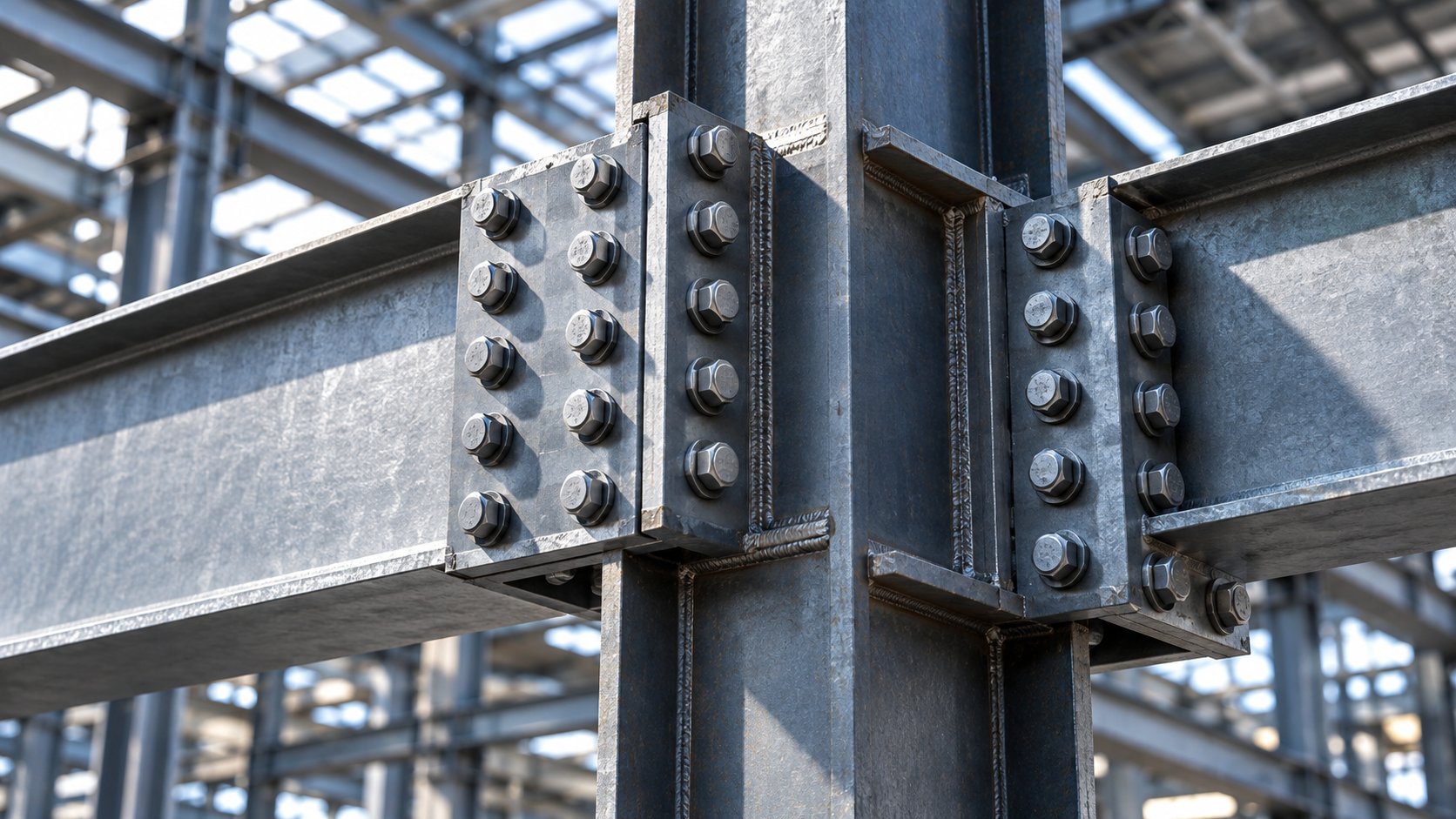
A bolted connection joins steel members through pre-drilled holes and high-strength bolts, usually working together with splice plates, end plates, cleats, or gussets. In modern pre-engineered building systems, bolted connections are the default: the factory fabricates each member to final length, drills every hole to a coordinated pattern, and ships the members with their connecting plates already welded or attached where shop welding is required. On site, the erection crew assembles the frame with wrenches rather than welding machines.
The Main Types of Bolted Connections
Procurement teams do not need to design connections, but knowing the vocabulary helps you read drawings and quotations accurately. The most common bolted joint families in steel structure buildings are:
- Bearing-type connections. The most economical and most common category. The bolts transfer load through direct bearing against the hole walls and shear across the bolt shank. They allow small relative slip between plates, which is acceptable in the vast majority of building frames.
- Slip-critical (friction-grip) connections. The plates are clamped so tightly by high-strength bolts that load transfers through friction between the faying surfaces, with no slip allowed. These are specified where slip would damage the structure or serviceability: crane runways, bridges subjected to repeated loading, bracing in tall or seismically active frames, and connections with oversized or slotted holes.
- End-plate connections. A plate welded to the beam end in the factory, then bolted to the column flange on site. Extended end plates can even develop full moment capacity for rigid frame joints, giving bolted frames near-welded levels of structural continuity.
- Splice connections. Bolted splice plates join segmented columns or rafters where transport limits exceed member length — standard practice for tall columns, long-span rafters, and containerized shipping.
- Base and anchor connections. Column base plates bolted to cast-in anchor bolts, transferring vertical load, shear, and moment into the foundation.
Why International Buyers Favor Bolted Systems
The advantages of bolted connections align almost perfectly with the priorities of overseas procurement. Erection speed is the headline benefit: a trained crew with impact wrenches and mobile cranes can erect a bolted frame dramatically faster than a crew performing structural welding, and erection can proceed in weather conditions that would shut down field welding. Skill independence is equally important on remote sites: certified structural welders are scarce and expensive in many project locations, while competent bolting crews are far easier to mobilize and supervise.
Quality traceability also favors bolting. Every bolt has a grade, a batch certificate, and a torque requirement; tightening can be checked with calibrated tools, and match-marking makes visual verification immediate. In a shop environment, hole drilling is CNC-controlled, so fit-up on site depends on factory accuracy rather than field judgment. This is precisely why leading pre-engineered building suppliers promote zero-field-welding systems: holes drilled before hot-dip galvanizing, match-marked bolted joints, and members that bolt together exactly as the drawings show.
Future flexibility is the third major advantage. Bolted connections can be loosened, adjusted, reinforced, relocated, or dismantled. A buyer who may expand a warehouse, relocate a mezzanine, or add a crane later benefits from a frame designed around bolted, reversible joints. Dismantling and resale or relocation of the asset — increasingly relevant for leased industrial facilities and mining camps — is only practical with a predominantly bolted structure.
The Limitations You Should Price Honestly
Bolted systems are not free of trade-offs. They require slightly more steel in plates and bolt groups than an optimized all-welded design would use for the same load path, so material tonnage can be marginally higher. Hole drilling adds fabrication steps, and hole patterns must be coordinated to tight tolerances across shop and site. Very heavily loaded joints — thick plates, large force reversals, or fatigue-critical details in long-span bridges — may demand large bolt groups or slip-critical surfaces that increase fabrication complexity. And loose or under-torqued bolts remain a real risk when erection supervision is weak, which is why supplier erection support and clear tightening procedures belong in your contract, not just on the drawings.
Welded Connections: How They Work and Where They Excel
Welded connections join members by fusing the base metal itself, using arc welding processes such as shielded metal arc welding (SMAW), gas metal arc welding (GMAW/MIG), flux-cored arc welding (FCAW), or submerged arc welding (SAW) in the shop. Welding eliminates splice plates, bolt groups, and holes; the load path is continuous, the joint is airtight, and the steel tonnage is typically the lowest of any connection method for the same load.
Shop Welding versus Field Welding
The single most important distinction for procurement purposes is where the weld is made. Shop welding happens in controlled factory conditions: pre-qualified procedures, certified welders, positioners, controlled temperature and humidity, and immediate access to inspection equipment such as ultrasonic testing (UT) and magnetic particle testing (MT). Shop welds — attaching end plates, stiffeners, cleats, and base plates to members before they ship — are standard practice in every serious fabrication shop and should be expected in any quotation.
Field welding happens on the erection site, and it inherits every site condition as a quality variable: wind, rain, dust, temperature, access scaffolding, power supply, welder fatigue, and the availability of testing services in the project country. Field welding can be the right answer in specific situations — very large or unusual joints, retrofit connections to existing structures, or modifications discovered during erection — but as a systematic joining strategy for a whole building, it concentrates risk exactly where control is weakest.
Where Welded Connections Are the Better Choice
Welding excels in scenarios where its strengths dominate. Heavy industrial frames with large plate girders, thick box columns, and high fatigue demand — heavy crane workshops, power plant buildings, long-span transfer structures — often use shop-welded built-up members with fully welded shop splices, because welded details are more compact and can be optimized for fatigue performance. Airtight or watertight assemblies, such as tank supports or specialized industrial enclosures, require welds by their nature. Weight-critical applications, including some bridge components and long-span trusses, benefit from the material efficiency of welded details. And complex architectural nodes — the curved intersections typical of airport terminals, stadium roofs, and feature towers — frequently require shop-welded nodes because the geometry cannot be resolved with standard bolted fittings.
The Limitations You Should Manage in the Contract
Field welding demands certified welders, qualified welding procedure specifications, electrode storage and handling control, weather protection, and post-weld inspection — all of which cost money and time on site, in your country, under your supervision or your contractor's. Field welds on galvanized members destroy the zinc coating in the heat-affected zone and require wire brushing and zinc-rich paint repair, a maintenance liability for the life of the building. Welded joints are also permanent: modification, expansion, or dismantling requires cutting, which damages the members and complicates reuse. None of these limitations makes welding a poor choice — they simply mean that welded connections shift quality and lifetime-maintenance obligations onto the site phase, and your procurement terms should reflect that.
Bolted versus Welded: The Twelve Factors That Decide Real Projects
The table below summarizes the comparison across the factors that most often decide international steel building projects. The discussion that follows explains the nuances that a table cannot capture.
| Decision factor | Bolted connections | Welded connections |
|---|---|---|
| Erection speed on site | Fast; weather-tolerant; crane-and-wrench workflow | Slower; weather-sensitive; sequence-dependent |
| Site skill requirement | Trained bolting crew; widely available | Certified welders; scarce in many markets |
| Quality control environment | CNC drilling + torque verification; site checkable | Excellent in shop; difficult to control on site |
| Material efficiency | Slightly higher (plates + bolts) | Most efficient load path |
| Fabrication cost | Drilling + plate work | Welder hours + inspection; efficient for heavy joints |
| Corrosion protection compatibility | Excellent with hot-dip galvanizing; coating intact | Field welds burn zinc; repair coating required |
| Fatigue and heavy cyclic load | Slip-critical details perform well | Excellent with proper detail and inspection |
| Future modification / expansion | Reversible; bolts can be adjusted or removed | Permanent; changes require cutting |
| Inspection over service life | Simple visual and torque checks | NDT needed for suspected defects |
| Dismantling / relocation value | High; asset can be unbolted and moved | Low; cutting damages members |
| Weather dependence during erection | Low | High (wind, rain, humidity affect weld quality) |
| Risk location | Factory (controlled) + tightening procedure | Site (contractor skill and conditions) |
Speed, Schedule, and Weather Risk
For an overseas project, the erection window is exposed to every logistical uncertainty in the chain: vessel delays, port congestion, customs clearance, foundation readiness, and local labor availability. A bolted frame compresses the on-site critical path because members go up as fast as the crane can place them, and bolting proceeds in conditions that would force welding to stop. Field welding, by contrast, needs dry surfaces, wind protection, and preheating in cold weather; a single week of monsoon rain or desert windstorm can push a weld-dependent schedule out by weeks. Buyers building in tropical, coastal, or high-wind regions should treat this schedule asymmetry as a real cost line, not a theoretical one.
Quality Risk and Where It Lives
A useful mental model: welding concentrates quality risk in people and site conditions; bolting concentrates it in factory accuracy and installation procedure. If your supplier has a mature fabrication shop — CNC drilling, controlled welding lines, in-house inspection teams, and certification such as ISO 9001, CE, SGS, and BV auditing — then a bolted-dominant system effectively moves almost all connection quality into the controlled environment, where it can be verified before shipment. If your erection contractor in the destination country is strong on welding and weak on bolting procedure, the calculus can shift; but for most international projects, the factory-controlled path is the safer default because it is inspectable before the steel leaves the port.
Corrosion: The Interaction Buyers Underestimate
Hot-dip galvanizing to ISO 1461 — for example, a coating of at least 275 g/m² — is one of the most cost-effective corrosion protection strategies for steel building frames in humid, coastal, and agricultural environments. Bolting and galvanizing are natural partners: holes are drilled before galvanizing, the molten zinc coats every surface including inside the holes, and the coating arrives on site intact. Field welding on a galvanized frame locally destroys the coating, produces fumes from the zinc, and leaves repair areas whose long-term performance depends entirely on the diligence of the site crew. In ammonia-rich livestock buildings, fertilizer plants, coastal warehouses, and humid tropical workshops, this interaction alone is often decisive in favor of a bolted system.
Seismic Behavior and Connection Ductility
In earthquake-prone regions, connection detailing must deliver ductility — the ability to deform without brittle failure. Modern seismic design achieves this through careful selection of where yielding occurs, and both bolted and welded solutions can be detailed to perform. Extended end-plate bolted moment connections are widely used in seismic frames because they combine ductility with shop quality control; welded moment connections are equally established when weld access, backing bars, and inspection are properly engineered. The procurement takeaway is not that one method is seismically safe and the other is not — it is that seismic projects demand a supplier whose engineers understand the governing code in your country and can document the connection design, whichever method is chosen.
Total Cost of Ownership, Not Just Tonnage Price
Bolted systems may show marginally higher steel tonnage and drilling cost on the fabrication quote; welded systems may show lower tonnage but higher site labor, inspection, weather protection, and coating-repair cost. Over the life of the asset, bolted systems also preserve options: adding a mezzanine, extending a bay, relocating a building, or replacing a corroded member is simpler and cheaper when joints are reversible. Sophisticated buyers evaluate the connection decision on total delivered and lifecycle cost — fabrication plus shipping plus erection plus inspection plus future flexibility — rather than on the fabrication line item alone.
How Climate and Site Conditions Change the Answer
The same building program justifies different connection strategies in different environments, and international buyers should make the site analysis explicit in their specification.
- Coastal and marine atmospheres. Salt spray accelerates corrosion at any coating break. A fully bolted, hot-dip galvanized frame with sealed, coating-intact joints minimizes maintenance; any field welding should be exceptional and followed by rigorous zinc repair.
- Tropical and high-humidity regions. Condensation and biological atmospheres (for example, ammonia in livestock buildings) attack both steel and coatings. Bolting preserves galvanizing; field welding creates permanent weak points in the coating system.
- Desert and high-temperature regions. Thermal expansion ranges are wide, and sand-laden wind complicates field work. Bolted erection proceeds quickly between wind events, and slip-critical connections handle thermal movement cycles reliably.
- Cold and snow-load regions. Field welding in freezing conditions requires preheating and enclosures, raising cost and risk; bolting is indifferent to cold. Connection design must address snow drift loads and brittle-fracture considerations at very low temperatures, which is an engineering task for your supplier's design team regardless of joining method.
- Remote sites with limited infrastructure. Where certified welders, inspection services, or stable site power are hard to secure, a zero-field-welding bolted system removes the dependency entirely.
Agricultural projects illustrate the point concretely. A prefabricated galvanized steel structure pig shed operates in a corrosive, wash-down environment where every coating break matters; bolted, galvanized connections are the practical default. The same logic applies to an agricultural light steel farm shed building serving mixed uses in humid climates.
Recommended Connection Strategies by Building Type
Project type shapes the optimal mix of shop welding and field bolting. The recommendations below reflect common practice in pre-engineered and engineered steel buildings, and they align with how an experienced fabricator sequences the work.
- Portal frame workshops and warehouses. The classic case for a bolted system: factory-welded end plates and base plates, factory-drilled holes, and entirely bolted field splices. A hot-dip galvanized portal frame steel workshop with a zero-field-welding bolted connection system demonstrates the approach at its cleanest — holes drilled before galvanizing and match-marked joints for error-free erection.
- Light-frame warehouses and logistics buildings. Speed to operation is the priority, and modular bays (for example, 6–9 m spacing) with bolted splices support both fast erection and later expansion. See a light steel frame metal structure warehouse or a prefabricated construction portal frame warehouse for typical configurations.
- Heavy crane workshops and industrial plants. A hybrid: shop-welded built-up columns and crane girders (where weld quality is controlled and fatigue details can be optimized), with bolted field splices and bolted crane-bracket connections for erection practicality. A purpose-built prefabricated crane steel structure workshop or a heavy steel structure factory building typically follows this pattern.
- Long-span sports venues and airport terminals. Complex geometry demands heavy shop welding of nodes and curved members; field connections remain bolted wherever access and schedule allow. The engineering emphasis is on node fabrication accuracy and erection sequencing.
- Bridges. Fatigue and repeated loading dominate. Modern practice uses shop-welded plate girders with bolted (often slip-critical) field splices — the hybrid at its most codified. A modular steel girder or arch bridge designed for bolted site assembly combines transport-friendly modules with controlled field joints.
- Aircraft hangars. Very large clear spans and heavy sliding doors create large forces at few joints; shop welding for major members with bolted splices keeps shipping dimensions manageable. A prefabricated steel structure aircraft hangar is a typical application.
Notice the consistent pattern: weld in the shop where control is high; bolt on site where conditions are uncertain. Projects that invert this pattern — heavy field welding of primary members — deserve extra scrutiny in your supplier evaluation.
The Hybrid Approach: Shop Welding Plus Field Bolting
The most reliable international projects rarely choose one method exclusively; they allocate each method to the phase where it performs best. In practice this means the fabrication shop performs all welding that attaches plates, stiffeners, and fittings to members — under certified welders, controlled procedures, and in-house ultrasonic inspection — while the site phase consists of bolting members together per match-marked drawings.
This hybrid delivers four compounding benefits. First, it minimizes the tonnage penalty of bolting, because plates and cleats are welded (not bolted) to members in the shop. Second, it maximizes erection speed, because no site welding is on the critical path. Third, it protects the galvanizing system, because holes are drilled before hot-dip galvanizing and no site hot work disturbs the coating. Fourth, it simplifies your quality audit: nearly all connection quality can be verified at the factory before shipment, and the site phase becomes a controlled, procedurally simple assembly task.
When you receive quotations, ask explicitly how much field welding each option assumes. Two quotes for the "same" building can differ substantially if one includes 300 field welds and the other includes none. The bolted option may quote slightly higher on fabrication and be significantly cheaper in delivered, erected, and inspected cost — and materially lower in schedule risk.
Common Buyer Mistakes When Specifying Connections
Across many international projects, the same specification errors recur. Avoiding them costs nothing and prevents the most frequent disputes.
- Specifying the method instead of the performance. Stating "all welded" or "all bolted" as an absolute can force uneconomic details. Specify performance — loads, codes, corrosion environment, erection constraints — and let qualified engineers select details, while requiring that field welding be minimized and justified.
- Ignoring the corrosion-protection interaction. Ordering galvanized frames and then accepting field-welded connections defeats the coating system. If site welding is unavoidable, require written zinc-repair procedures and materials.
- Accepting field welding without inspection logistics. Who performs ultrasonic or magnetic particle testing on site welds, with what equipment, and against which acceptance criteria? If the answer is not in the contract, quality risk has been silently transferred to you.
- Underestimating bolting procedure. Bolting is simple but not casual: calibrated wrenches, specified tightening sequences, and match-marking checks matter. Require an erection method statement covering both crane sequence and connection tightening.
- Forgetting future expansion. Buyers who expect to extend a building later should demand bolted end-wall frames, bolted splices sized for extension loads, and purlin systems that continue across the expansion line — retrofit welding is the expensive alternative.
- Leaving tolerances undefined. Hole tolerances, anchor bolt positioning tolerances, and member length tolerances determine whether a bolted frame actually goes together. Anchor bolts cast even slightly out of position are a leading cause of site delay; agree tolerances and verify templates before shipment.
Connection Design Deliverables to Require Before Shipment
On international projects, the documents you receive before the steel is packed are your principal instrument of connection quality control — because after the vessel sails, every connection defect becomes a site problem in your country instead of a factory problem in the fabricator's. A capable supplier will provide, and you should contractually require, a defined deliverables package covering the connections from design through packing.
At minimum, ask for the following items and review them against your specification before authorizing production:
- Connection design calculations referenced to the governing code for your jurisdiction, showing each joint family, its design forces, and the utilization of the chosen detail. This is your evidence that the bolted or welded solution was engineered, not assumed.
- Shop drawings with hole patterns for every member, showing hole diameters, gauges, pitches, edge distances, and plate thicknesses. These drawings drive CNC drilling, so their accuracy determines site fit-up.
- A complete bolt schedule listing bolt grades, diameters, lengths, quantities, and the tightening method for each joint family. The bolt schedule is also your procurement check against shortages on a remote site.
- Welding documentation for shop welds: the welding procedure specifications used, a summary of welder qualifications, and the scope and results of non-destructive testing such as ultrasonic inspection.
- Coating records, including galvanizing certificates where hot-dip galvanizing is specified, so coating mass and coverage can be verified against the contract.
- A match-marking diagram mapping every mark on the steel to the erection drawings, which is what allows a site crew to assemble thousands of members without ambiguity.
- A packing list sequenced to the erection plan, so containers can be opened in the order the crane needs them — a small document that meaningfully compresses site time.
- An erection manual covering crane assumptions, member sequence, bolting procedures, torque values, and inspection hold points.
Reviewing this package costs a few days of engineering attention before shipment; discovering a missing deliverable after arrival costs weeks. Buyers who make the deliverables list contractual, with inspection approval as a payment or shipment milestone, consistently report smoother erections and fewer claims — not because problems never occur, but because they are caught while they are still cheap to fix.
How a Professional Steel Structure Supplier Engineers Connections
Understanding what happens inside a capable fabricator helps you evaluate quotations beyond price per ton. At Jidian Construction Materials Co., Ltd., a steel structure manufacturer based in Xiamen, Fujian, China, with an annual capacity of 360,000 tons of steel structures and 1,000,000 m² of building enclosure systems, the connection workflow is integrated from design to delivery, and the same philosophy applies across the product range: resolve every joint possible in the factory, and ship the site a bolting task rather than a welding project.
Design and detailing. Engineers model the frame, size members from grades such as Q345B/Q355B, and design each connection against the governing code for the destination market, producing coordinated shop drawings in which every hole pattern, plate thickness, and bolt grade is explicit. The company has participated in the formulation and review of Chinese national steel structure standards and specifications, and its design office works to the code applicable to each project's jurisdiction.
Fabrication. CNC drilling produces hole patterns to controlled tolerances; shop welding attaches end plates, cleats, and stiffeners under certified procedures; and where hot-dip galvanizing is specified, drilling precedes galvanizing so the coating covers every surface, including hole walls. Members are match-marked so the site crew can assemble the frame without interpreting drawings bolt by bolt.
Quality control. An in-house inspection team controls raw material quality, performs ultrasonic inspection of welds, verifies derusting grades, and checks dimensions before packing; the quality management system is supported by ISO 9001, CE, SGS, and BV certification. Connection components — bolts, plates, members — are counted, match-marked, and packed to erection sequence, so containers arrive in the order the crane needs them.
Delivery and erection support. Production for a typical portal frame project runs 20–30 days after drawing confirmation, and packing is planned for container efficiency and erection order. Erection drawings, tightening procedures, and sequence plans accompany the shipment, and the engineering team remains available through the erection phase — the practical expression of a zero-field-welding connection philosophy serving customers in more than 50 countries.
The strategic point for buyers: a supplier that designs, fabricates, coats, inspects, and packs connections as one integrated process removes coordination risk that no amount of site supervision can recover. Connection quality is created in the factory; the site either preserves it or destroys it.
Questions to Ask Before You Sign the Contract
Use this checklist in supplier discussions. A capable manufacturer will answer every question with documents, not adjectives.
- What percentage of connections are bolted on site, and which joints (if any) require field welding? Why?
- Are holes drilled before hot-dip galvanizing, and what coating mass is specified (for example, per ISO 1461)?
- Which bolt grades and connection types (bearing or slip-critical) are proposed for each joint family, and what tightening procedure is specified?
- What shop welding certifications, welding procedure specifications, and non-destructive testing apply to shop welds?
- How are members match-marked and packed, and does the packing sequence follow the erection plan?
- Which design code governs the connection design in my country, and can the supplier document compliance?
- What anchor bolt tolerances and templates are provided to the foundation contractor?
- What erection supervision, method statements, and after-sales support are included?
Related reading for a complete procurement picture: our guide to how foundations and erection methods affect project cost and timeline, the buyer's overview of anti-corrosion coating systems for coastal, industrial, and tropical projects, our engineering guide to designing steel buildings for heavy snow loads and extreme cold, and the explanation of how steel structure buildings can be expanded after construction.
Frequently Asked Questions
Are bolted connections as strong as welded connections?
Properly designed bolted connections are fully capable of developing the strength a building frame requires, and modern codes treat bolted and welded design as equally valid paths. What differs is the detail: welding gives a continuous load path with compact geometry, while bolting transfers load through plates and bolt groups. For the load levels typical of workshops, warehouses, and most industrial buildings, a well-designed bolted system meets every structural requirement with the added benefits of speed and reversibility. For certain fatigue-critical or geometrically complex joints, welded details are preferred — which is why hybrid systems are standard practice.
Why does field welding damage galvanized coatings?
Galvanizing is a zinc coating applied by dipping steel in molten zinc. Arc welding locally melts the steel surface, burning away the zinc in and around the weld zone and producing zinc fumes. The exposed area must be cleaned and repaired with zinc-rich coating, and repaired areas rarely match the durability of the original continuous galvanized layer. This is why drilling before galvanizing plus bolted field assembly — with zero field welding — preserves the full corrosion protection system for the life of the building.
How is bolted connection quality verified on site?
Through a combination of factory controls and site procedures: mill certificates for bolt grades, calibrated torque wrenches or turn-of-nut methods with specified inspection, match-marking between connected parts to confirm correct assembly, and visual checks that all plies are in full contact. Because the holes were CNC-drilled in the factory and members are match-marked, fit-up problems are rare and immediately visible — unlike hidden weld defects, which require non-destructive testing to detect.
When would a buyer deliberately choose field welding?
Legitimate cases include connecting new steel to existing structures where bolt access is impossible, very large joints that exceed practical shipping limits, late modifications discovered during erection, and certain retrofit or strengthening works. In these cases, require certified welders, approved procedures, weather protection, and a defined inspection plan — and treat the coating repair scope as part of the same work package.
Does a bolted system cost more?
Fabrication tonnage can be marginally higher because plates and bolts add material, and drilling is an added process. But total delivered cost often favors bolting once site labor, erection duration, inspection logistics, weather risk, and future flexibility are counted. The correct comparison is lifecycle cost of the erected, inspected, maintainable building — not the fabrication line item in isolation.
How do bolted connections perform in high-wind and cyclone regions?
Wind loading challenges connections differently from gravity loading: uplift reverses forces in roof systems and bracing, cyclic gusting introduces repeated load reversal, and total structural separation is the consequence of a systemic joint failure. Well-designed bolted frames handle these demands through slip-critical bracing connections, end plates sized for reversal, and base connections anchored for uplift — provided the design wind speed and exposure category for your site were stated at quotation stage. The practical buyer action is to supply the project's basic wind speed and terrain category explicitly, then confirm the supplier's connection design covers roof sheeting attachment, purlin-to-rafter joints, and bracing pre-tension, which are the elements most often under-specified in cyclone-prone markets.
What maintenance do bolted and welded connections need over the building's life?
As a general maintenance practice for steel buildings in aggressive environments, buyers commonly schedule periodic visual inspections of connections — checking for coating breakdown, surface rust at joints, water ponding at base details, and, for bolted connections, any evidence of loosening — with frequency scaled to the corrosiveness of the site. Hot-dip galvanized bolted frames typically need little beyond coating touch-up at mechanical damage points, while painted welded structures usually require earlier and more frequent coating maintenance at weld lines and edges. Whatever the system, drainage details around base connections deserve regular attention, because standing water at the foundation line is the most common initiator of long-term connection corrosion in the field.
Can an existing welded steel building be converted to bolted connections?
Partial conversions are common: adding bolted splices during an extension, replacing a corroded welded joint with a bolted repair detail, or bolting new attachments (mezzanines, platforms, equipment supports) to the existing frame to avoid hot work. A full conversion is rarely economical, but targeted bolted modifications are a practical way to upgrade or extend a welded structure — subject to engineering assessment of the existing members.
Conclusion: Match the Connection Method to the Project, and Keep the Factory in Control
The bolted-versus-welded question is best answered as a logistics and lifecycle question rather than a strength question. Both methods, properly engineered, deliver safe structures. What separates successful international projects from troubled ones is where the quality risk lives: in a controlled factory with certified processes and in-house inspection, or on a distant site with variable weather, scarce specialists, and limited testing access. The consistent pattern across workshops, warehouses, farm buildings, hangars, bridges, and venues is to weld in the shop where control is highest, bolt on site where conditions are uncertain, and preserve the corrosion protection system by keeping hot work off a galvanized frame.
If your next project requires a steel structure building engineered for fast, reliable, coating-intact assembly — from a galvanized portal frame workshop to a heavy industrial factory building — send us your drawings, loads, and site conditions. Our engineering team will review the connection strategy with you, document the bolted and welded scope in the quotation, and support the erection phase through delivery to more than 50 countries. Contact Jidian Construction Materials Co., Ltd. for a connection-level quotation and a schedule you can plan around.