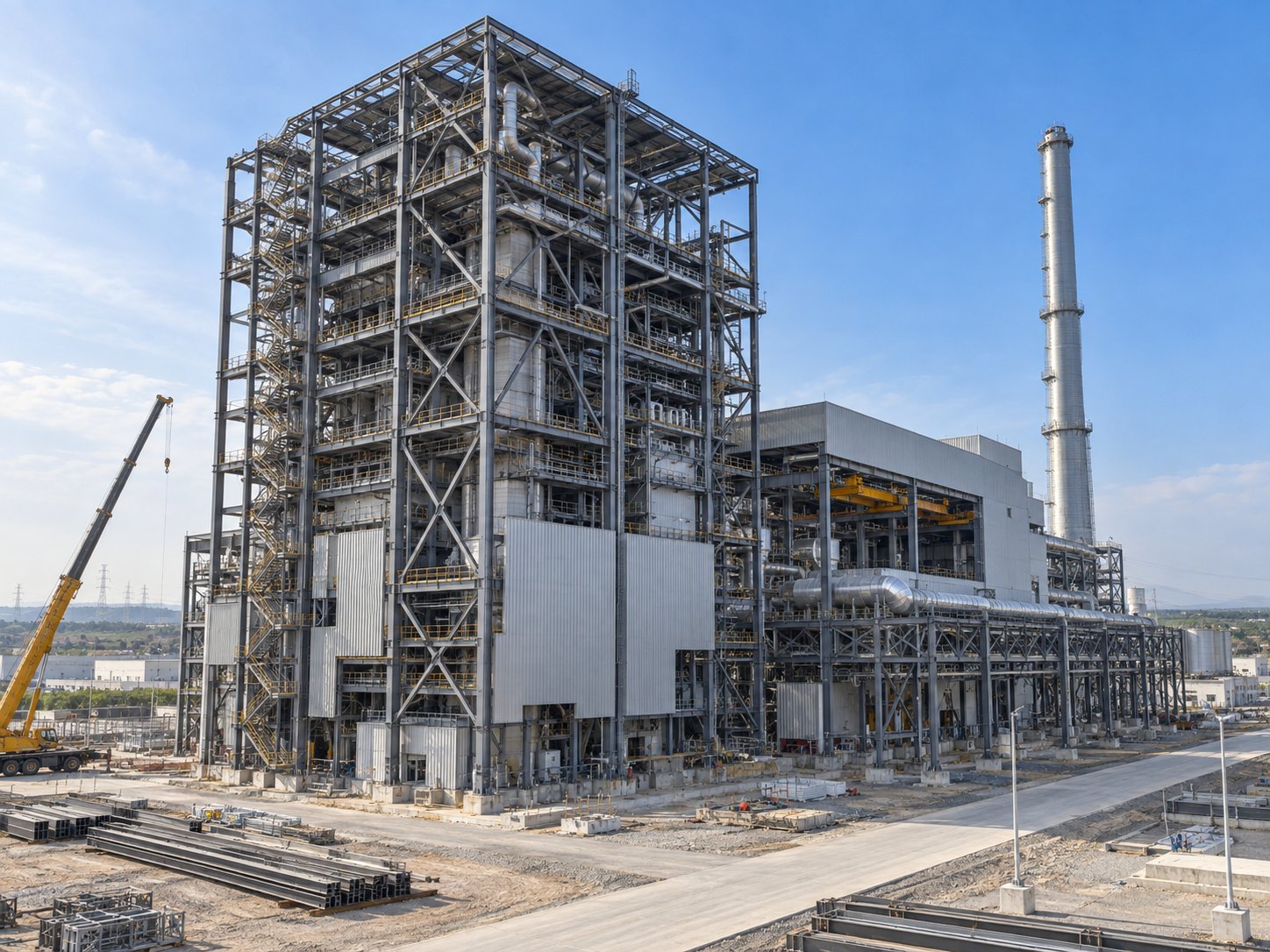
Steel Structure Power Plant Building
Highlights
- Boiler load path designed into the primary frame - main columns and girders are sized for the full 200-800 t suspended boiler weight, with suspension brackets shop-welded at designed elevations instead of field-fabricated onto unsized members
- Turbine vibration isolation - turbine-generator pedestal foundations are structurally separated from the main building frame, with expansion joints at the boiler-turbine interface to prevent alignment drift and premature bearing wear
- High-temperature durability - boiler enclosure zones use a silicone-modified topcoat rated for 300 °C continuous exposure with aluminum silicate fiber insulation behind the cladding
- Heavy crane runway - turbine house crane beams pre-engineered for 50-200 t maintenance cranes, with bracket connections and stiffener details designed for the crane load spectrum
- Seismic amplification design per GB 50260 - the frame accounts for equipment mass distribution and mass irregularity in tall, top-heavy power plant buildings, not only uniform building loads
- EPC schedule alignment - 360,000 t/year capacity with dedicated production lines for 3,000-5,000 t steel requirements, delivering a 300 MW main building in 60-90 days
Product Detail
Steel Structure Power Plant Building for Thermal Power Generation
This steel structure power plant building is engineered for the main building of thermal power plants: a tall boiler house frame carrying suspended boiler loads, and an adjacent turbine house with an overhead crane runway. The primary frame uses Q355B/Q390B welded H-section and box-section members, with the boiler suspension load path designed into the main columns rather than added on site.
One Problem EPC Contractors Keep Hitting: Boiler Load Paths Added After the Frame Is Designed
The recurring failure on thermal power projects is not the steel itself, it is the sequence. A generic industrial frame is designed first, then the boiler vendor issues suspension point loads of 200-800 tons, and the contractor has to weld brackets onto columns that were never sized for them. The result is field-fabricated connections, local plate reinforcement, and a load path that no longer matches the original structural calculation.
How this building solves it
Boiler suspension loads are treated as a primary design input, not a late addition. The main frame columns and girders are sized for the full suspended boiler weight, and the suspension brackets are shop-welded to the column faces at the designed elevations. Load paths from the suspension points down to the foundations are part of the primary frame calculation, so no field welding onto primary members is required.
The same principle applies at the boiler-turbine interface. Turbine-generator pedestal foundations are structurally separated from the main building frame, and expansion joints at the interface prevent vibration transmission that would otherwise cause turbine alignment drift and premature bearing wear. Flue gas duct and steam piping supports are pre-engineered at designed locations and temperatures, so site teams are not drilling into structural members for hangers.
For scale: a 300 MW thermal power plant main building, typically 50 m span, 60 m height and 120 m length, requires 3,000-5,000 tons of structural steel. Our annual capacity of 360,000 tons allows dedicated production lines for a project of this size, with delivery in 60-90 days after drawing confirmation.
Technical Specifications
| Parameter | Specification |
|---|---|
| Brand | Jidian Construction Materials Co., Ltd. |
| Product origin | Xiamen, Fujian, China |
| Building type | Thermal power plant main building (boiler house + turbine house) |
| Main steel grade | Q355B / Q390B welded H-section and box-section columns; Q355B lattice girders for roof |
| Boiler house clear span | 30-55 m |
| Turbine house clear span | 20-30 m |
| Boiler house eave height | 40-70 m |
| Turbine house eave height | 20-35 m |
| Boiler suspended load | 200-800 t, designed into the primary frame |
| Overhead crane capacity | 50-200 t (turbine house maintenance crane) |
| Boiler enclosure contact temperature | 150-400 °C at the enclosure surface, with heat shielding between the hot surface and the coated steel |
| Coating system - turbine house | Sa 2.5 blast + epoxy zinc-rich primer (2 x 75 μm) + polyurethane topcoat |
| Coating system - boiler enclosure | Sa 2.5 blast + epoxy zinc-rich primer (2 x 75 μm) + silicone-modified high-temperature topcoat rated 300 °C continuous at the coated steel surface; zones above 300 °C use additional insulation so the coating interface stays within its rating |
| Wind load | Up to 0.7 kN/m² (approx. 160 km/h) |
| Seismic design | Chinese seismic intensity Grade 8, with amplified demand on top-heavy equipment zones |
| Vibration isolation | Turbine pedestal foundations separated from main frame; expansion joints at boiler-turbine interface |
| Cladding options | Corrugated steel plate; rock wool sandwich panel (fire-rated); aluminum silicate fiber insulation for boiler zones |
| Fabrication tolerance | ±2 mm general (CNC plasma cutting, automated SAW, robotic drilling); box-section columns ±1 mm on parallel faces |
| Expected service life (not a warranty) | Structural steelwork is designed for a 50+ year service life under normal industrial atmospheric exposure with routine inspection; the high-temperature coating is expected to serve 15-20 years before planned recoating. These are design expectations, not warranty periods. |
| Warranty period | 12 months from delivery for structural steelwork and for the coating system, against fabrication and coating defects under the specified service conditions |
| Manufacturing standard | GB 50017, GB 50260, ISO 15614-1, ISO 9606, AWS D1.1 |
| Minimum order | One complete power plant building project (quoted per project, not per ton) |
| Delivery time | 60-90 days after drawing confirmation for a 100-300 MW main building; 300-600 MW and more complex plants are scheduled individually after the structural design is reviewed |
| Supply capacity | 360,000 t/year |
Product Advantages and Core Features
- Boiler load integration - main frame columns and girders are structurally designed for the full suspended boiler weight of 200-800 t, with suspension brackets shop-welded at designed elevations instead of field-fabricated.
- Turbine vibration isolation - turbine-generator pedestal foundations are structurally separated from the main building frame, with expansion joints at the boiler-turbine interface.
- High-temperature durability - boiler enclosure zones use a silicone-modified high-temperature topcoat rated for 300 °C continuous exposure, with aluminum silicate fiber insulation behind the cladding.
- Heavy crane runway - turbine house crane runway beams are pre-engineered for 50-200 t maintenance cranes, with bracket connections and stiffener details designed for the crane load spectrum.
- Seismic amplification design - frame design accounts for equipment mass distribution and mass irregularity per GB 50260, not only uniform building loads.
- Piping and ductwork integration - support brackets for flue gas ducts, steam piping and cable trays are pre-engineered at designed locations and temperatures.
- EPC schedule alignment - 360,000 t/year capacity with dedicated production lines for 3,000-5,000 t steel requirements, delivering a 300 MW main building in 60-90 days.
Manufacturing, Quality Control and Factory Capability
Steel processing and welding
CNC plasma cutting prepares H-section plates and box-section components to dimension. Automated submerged-arc welding (SAW) joins main columns, girders and crane runway beams with full-penetration welds. Box-section columns used for high-load boiler house supports are welded on dedicated jigs to maintain ±1 mm parallel-face tolerance. The secondary processing line holds ±2 mm bolt-hole positioning.
Welding qualification and non-destructive testing
Welding procedures are qualified to ISO 15614-1 and AWS D1.1, and welders hold ISO 9606 certification. Every primary load-bearing weld undergoes 100% ultrasonic testing (UT) per GB/T 11345. Radiographic testing (RT) is applied to critical butt welds in boiler house main columns, and magnetic particle inspection (MT) covers secondary connections and crane bracket details. Weld records are archived per power industry QA requirements.
Surface treatment and coating control
Surface preparation reaches Sa 2.5 (ISO 8501-1) before coating. The turbine house system is epoxy zinc-rich primer (2 x 75 μm) plus polyurethane topcoat; boiler enclosure zones use a silicone-modified high-temperature topcoat rated for 300 °C continuous exposure. Coating thickness is verified per batch with calibrated gauges.
Pre-shipment inspection
Mill certificates are matched to steel batches with traceability to heat numbers. UT, MT and RT records are verified and archived. Critical dimensions including box-section column squareness, crane runway beam straightness and bolt-hole patterns are checked against shop drawings, and out-of-tolerance components are reworked before loading.
Factory capability
Jidian operates heavy steel, light steel and sandwich panel production lines in Xiamen, Fujian, with an annual capacity of 360,000 tons of steel structures and 1,000,000 m² of building enclosure output. The facility is equipped with manufacturing technology from the United States, Japan, Germany and Italy, and the company has participated in the formulation and review of Chinese national steel structure standards and specifications.
Company Strengths for Procurement Decisions
- Manufacturing scale - 360,000 tons/year steel structure capacity and 1,000,000 m²/year enclosure output from heavy steel, light steel and sandwich panel lines.
- Standards participation - involvement in the formulation and review of Chinese national steel structure standards and specifications.
- Certifications - the company holds ISO 9001, ISO 14001, ISO 45001, CE (EN 1090), SGS and BV certification, plus China Steel Structure Manufacturing Special Level Qualification. These are company-level certificates; the applicable scope and validity for a specific project can be confirmed during qualification review.
- Export coverage - projects delivered to 50+ countries and regions across Asia, the Middle East, Africa, Europe and South America, with 2,000+ completed projects.
- Integrated service - technical consultation, structural design, manufacturing, transportation, installation guidance and after-sales support from one supplier.
- Project experience - industrial buildings, warehouses and logistics facilities, commercial and public buildings, long-span structures, bridges and marine engineering.
Warranty, After-Sales and Scope Boundaries
Structural steelwork is warranted against fabrication defects for 12 months from delivery, covering welding defects, dimensional non-conformance against approved shop drawings and material traceability. The coating system is warranted for 12 months from delivery against coating defects under the specified service conditions. The 50+ year structural service life and the 15-20 year coating life stated in the specification table are design expectations under normal industrial atmospheric exposure with routine inspection, not warranty periods; recoating after the coating service life is planned maintenance and is quoted separately. Project-specific warranty terms and exclusions such as site damage, unauthorized modification and abnormal operating conditions are stated in the contract.
After-sales support includes assembly drawings, connection sequence drawings and remote technical support for the full erection period. On-site engineer supervision is quoted separately and covers travel, accommodation and a daily rate; the number of days and the responsibility split between our engineer and the site contractor are agreed before mobilization.
This building system is designed for thermal power generation main buildings, including coal, gas and biomass plants, and for cogeneration facilities. It is not offered as a standard solution for nuclear containment structures or for sites where the specified wind, snow or seismic loads exceed the design ranges listed above; those cases are reviewed individually before quotation.
Packaging, Shipping and Export Documentation
Heavy power plant columns and girders are bundled on timber dunnage with steel strapping, and coated surfaces are fabric-wrapped at the ends. Hardware and small parts are packed in labeled iron boxes. Shipments leave Xiamen Port in 40 ft OT or flat-rack containers, with oversized box-section columns loaded on flat-rack when they exceed container dimensions. Multiple shipments can be sequenced to match site assembly order.
Each shipment includes mill certificates with heat numbers, weld and NDT records, coating thickness reports, material traceability documentation, a packing list and a commercial invoice. FOB, CIF and DDP terms are available.
Procurement FAQ
What is the MOQ?
One complete power plant building project. This product is quoted per project rather than per ton, so the minimum order is a single main building scope, not a quantity of steel members.
What is the lead time?
60-90 days from drawing confirmation for a 100-300 MW main building. For 300-600 MW or more complex plants, the schedule is confirmed individually after the structural design is reviewed.
How is the structure shipped?
Heavy columns and girders on flat-rack containers or 40 ft OT, hardware in labeled iron boxes, shipped from Xiamen Port. Multiple shipments can be sequenced to match site assembly order.
How are components packaged?
Steel members are bundled on timber dunnage with steel strapping, and coated surfaces are fabric-wrapped. Each bundle is labeled with its drawing reference for site assembly sequencing.
What are the payment terms?
T/T (30% deposit, 70% before shipment) or L/C at sight. Milestone-based payment terms are available for large EPC contracts.
Do you offer OEM/ODM and private label?
Yes. We manufacture to EPC contractor specifications and can include your company branding on documentation and packaging.
Can I get a sample or a pre-production component?
For a project of this type, the equivalent of a sample is a shop-fabricated trial component or a first-article connection detail. Discuss the scope with our engineering team when you send your project data.
What warranty do you provide?
Structural steelwork and the coating system each carry a 12-month warranty from delivery against fabrication and coating defects under the specified service conditions. The 50+ year structural life and 15-20 year coating life are design expectations, not warranty periods. Project-specific terms and exclusions are stated in the contract.
Do you provide installation support?
Assembly drawings, connection sequence drawings and remote support are provided with every project. On-site engineer supervision is quoted separately and covers travel, accommodation and a daily rate, and is recommended for critical boiler house erection.
What do I need to provide for a quote?
Plant capacity (MW), boiler type and suspended load, turbine-generator weight, building dimensions, local wind, snow and seismic loads, crane requirements, and applicable local design codes. A preliminary structural scheme and price indication are returned within 72 hours when these inputs are complete; the formal construction drawing design is scheduled separately.
Send us your plant capacity, boiler specifications, turbine loads and local design codes. Our engineering team will review the requirement and prepare a structural design and quotation.
Related Products
FAQ
What quality certifications do your building materials hold?
Our products are manufactured under strict quality control systems and hold multiple international certifications including ISO 9001, CE, SGS, and BV. Jidian Construction Materials Co., Ltd. operates 26 production lines with advanced testing equipment, and every batch undergoes dimensional, material, and surface inspection before shipment. We also support third-party on-site inspection and pre-shipment testing by SGS, TUV, or other designated agencies. Mill Test Certificates (MTC) and quality reports are provided with every delivery.
Can I request product samples before placing a bulk order?
Yes, we provide product samples for evaluation. Small material samples such as steel coupons, panel cuttings, and fastener samples are provided free of charge, with the customer only paying for shipping. For larger samples or custom prototypes, a sample fee may apply, which is deductible from your bulk order. Please contact Jidian Construction Materials Co., Ltd. with your specific sample requirements and we will arrange shipment from our Xiamen facility promptly.
Can you print our company logo on the building materials or packaging?
Yes, we offer custom logo printing and branding services. Your company logo can be applied to product surfaces (such as panel edges, steel beam ends), packaging materials, and shipping marks. We use laser engraving, stenciling, or adhesive labeling depending on the material and your preference. This service is available for OEM orders with a reasonable MOQ. Provide us with your logo artwork (AI or vector format preferred) and we will incorporate it into the production process.
Do you provide OEM and custom manufacturing services?
Yes, Jidian Construction Materials Co., Ltd. offers comprehensive OEM and ODM services. With an annual steel processing capacity of 360,000 tons and 1,000,000 m² enclosure material output, we can manufacture products to your exact specifications, drawings, or samples. Our engineering team in Xiamen works closely with clients to optimize designs for cost-efficiency and structural performance. We have completed over 2,000 projects across 50 countries, delivering custom steel structures, panels, and building systems tailored to diverse market requirements.
How to install?
We will provide you with detailed installation drawings and video explanations. If necessary, we will send professional engineers to guide and experienced technical workers to help with installation.
How about your quality control?
We have a professional quality inspection team and advanced testing equipment. In addition, we support third-party testing, such as SGS, TUV, etc.
What is the payment terms?
T/T or L/C, 30% advance payment, 70% balance payment before delivery.
How long does your delivery time take?
It depends on the item, usually around 20—30 days.